
What Is a Concrete Chamfer? Sizes & Strip Types
Last Updated: 2026-11-12 · Wewin Magnet
Quick answer: A concrete chamfer is a small 45° bevel that replaces the sharp 90° corner of a concrete element. It is formed by placing a triangular chamfer strip inside the mould before the pour, so the edge comes out bevelled instead of square. Typical sizes are 3/4 in. (19 mm) in North America and 10–25 mm in metric markets. On steel casting beds, magnetic chamfer strips (steel or rubber) are a popular choice because they need no nails, glue or welding and can be reused cycle after cycle.
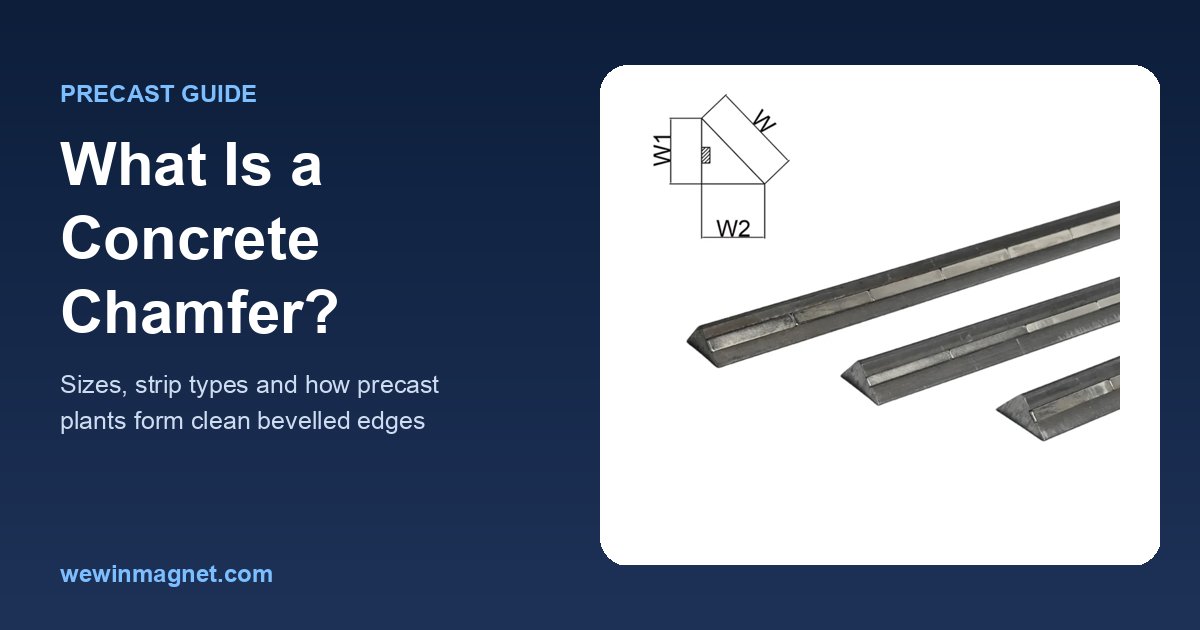
What is a chamfered edge in concrete?
A chamfered edge is a flat, angled face that joins two surfaces of a concrete element. In concrete it is almost always a symmetrical 45° bevel: a 20 mm chamfer removes a 20 × 20 mm triangle from the corner, leaving a sloped face about 28 mm wide.
It is different from a fillet, which is a rounded (radiused) corner. A chamfer gives a flat bevel; a fillet gives a curved transition. Which one you use depends on the drawings and the finish required.
The term also appears in woodworking, metalwork and CAD. In those fields a chamfer can be any angle. In concrete forming it means the bevelled corner produced by a chamfer strip, or occasionally by an edging tool on fresh concrete.
Why do precast plants chamfer exposed corners?
- Fewer chipped edges. A sharp corner is the weakest part of a fresh element. It is the first thing to spall when the element is demoulded, lifted, stacked and shipped. A bevel spreads the knock over a wider face.
- Easier stripping. A sharp concrete arris locks against the side form, while a bevel releases more cleanly when the shuttering is removed.
- Cleaner appearance. Bleed water and paste collect in square corners and leave honeycombing. A formed chamfer gives a straight, even line along walls, columns, beams, stairs and façade panels.
- Safer handling. Bevelled edges are less likely to cut hands, slings or lifting straps.
Chamfers are usually specified on permanently exposed outside corners. Hidden faces and edges that will be grouted against another element are often left square. Always follow the project drawings.
Which chamfer size should you use?
Chamfer size is the length of the two equal legs of the triangle. US forming suppliers stock inch sizes, and 3/4 in. is a standard size in most catalogues. Plants working in metric usually choose 10, 15, 20 or 25 mm. Note that 3/4 in. is exactly 19.05 mm, so order the exact leg size shown on the drawing rather than assuming 19 mm and 20 mm are interchangeable.
| Chamfer leg (mm) | Nearest inch size | Bevel face width | Typical use |
|---|---|---|---|
| 10 mm | 3/8 in. | ≈ 14 mm | Small elements, kerbs, slab edges, fine architectural lines |
| 15 mm | 5/8 in. | ≈ 21 mm | Wall panels, stair treads, hollow-core and solid slab edges |
| 20 mm | ≈ 3/4 in. (19.05 mm) | ≈ 28 mm | General default for columns, beams and exposed panel corners |
| 25 mm | 1 in. | ≈ 35 mm | Heavy elements, piers and corners that take frequent impact |
The bevel face width is the leg × 1.41 (for a 45° chamfer). If the drawing gives the face width instead of the leg, divide by 1.41 to find the strip size to order.
Four ways to form a concrete chamfer
The right strip depends mainly on what your moulds are made of and how many times the strip will be reused.
| Chamfer strip | How it is held | Reuse | Best for | Watch out for |
|---|---|---|---|---|
| Wood | Nailed to timber forms | Few pours | Site-cast work with timber formwork | Absorbs water, swells, can stain and pit the concrete |
| PVC / plastic | Nailed, stapled or glued; some are single-use | Low to medium | Tilt-up and site-cast walls | Fixing to steel moulds is slow; glue residue |
| Rubber magnetic | Magnet strip inside a flexible rubber profile | Many cycles | Steel pallets, curved or long runs, quick changeovers | Keep it clean of paste; protect from cuts |
| Steel magnetic | Permanent magnets embedded in a steel profile | Many cycles | High-volume precast on steel beds and pallet circulation lines | Heavier; corners need neat mitred joints |
Chamfer edgers are a fifth option for site work: a bevelled hand tool run along the form edge while the concrete is still workable, after bleeding has stopped and surface water has gone. The result depends on operator skill, so precast plants, where every element should come out of the mould identical, normally form the chamfer with a strip instead.
Need a quote for magnetic chamfers? Send us your mould type, chamfer size and total metres per line. We'll reply with a sizing and price proposal. Request a chamfer quote →
Magnetic chamfer strips for steel moulds
On a steel casting table or pallet, a magnetic chamfer simply clicks into place along the side form. There is nothing to drill or weld, and nothing to grind off afterwards. For plants that already use shuttering magnets and magnetic formwork systems, magnetic chamfers mean the whole mould can be set up and stripped with magnets.
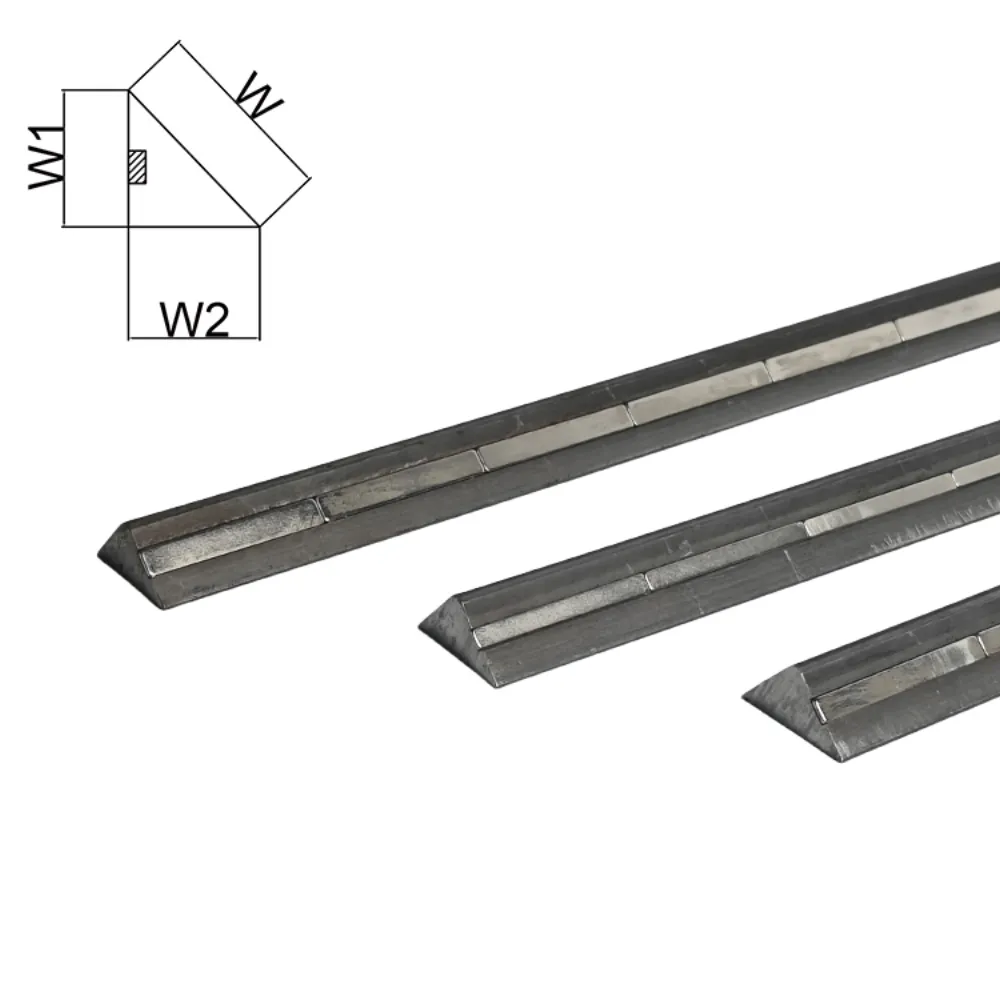
Steel magnetic chamfers are rigid 1 m bars. Use them where you need dead-straight lines and maximum durability. Our standard range:
| Model | Legs W1 × W2 (mm) | Bevel face W (mm) | Length | Weight |
|---|---|---|---|---|
| WWMC2-A1 | 10 × 10 | 14 | 1,000 mm | 0.5 kg/m |
| WWMC2-A2 | 15 × 15 | 21 | 1,000 mm | 1.1 kg/m |
| WWMC2-A3 | 20 × 20 | 28 | 1,000 mm | 1.7 kg/m |
| WWMC2-A4 | 25 × 25 | 35 | 1,000 mm | 2.4 kg/m |
The steel strips come in three triangular profiles (types A, B and C) with the magnets set into different faces. This lets the strip sit against the side form or flat on the pallet. Trapezoid profiles (WWMC3-A1 to A6, 15–40 mm wide) form flat-bottomed grooves or recesses. Other sizes are made on request.
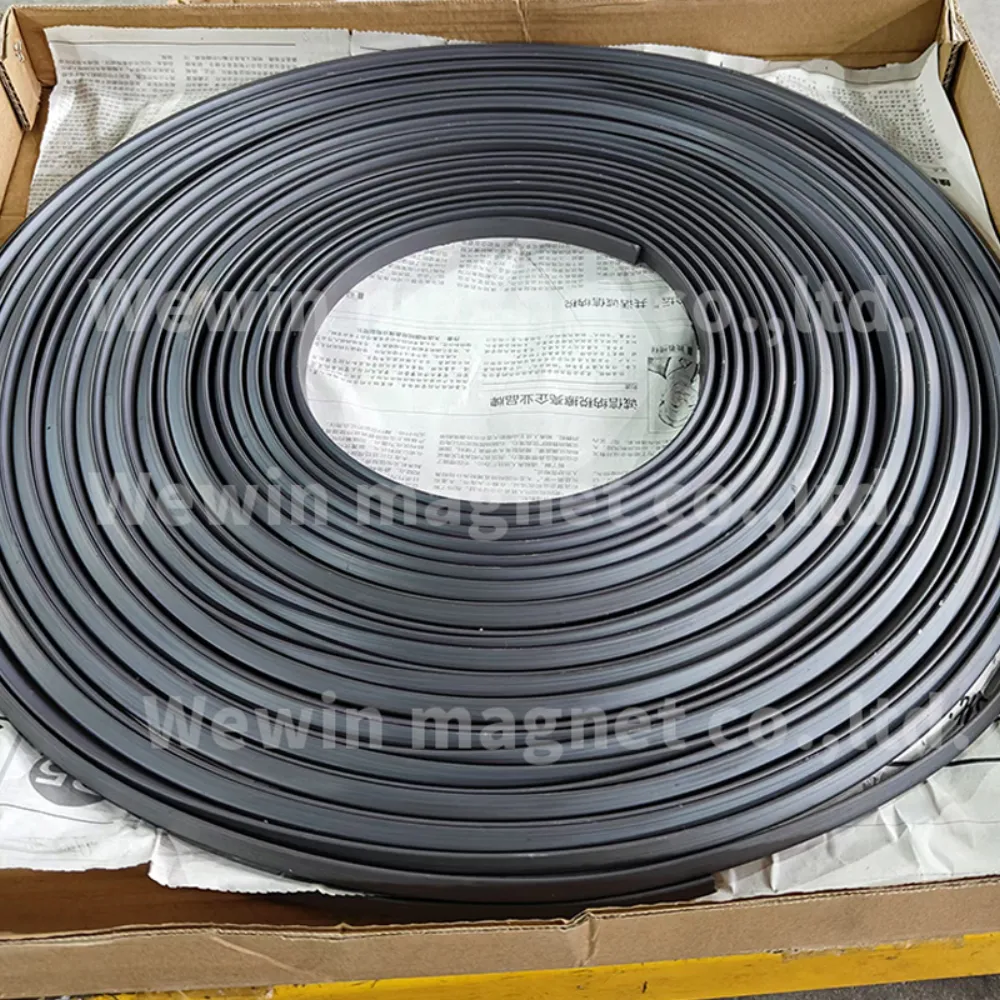
Rubber magnetic chamfers are flexible, so they can follow gentle curves and are lighter to handle on long runs. The WWMC-A1 to A3 triangles come in 10 × 10, 15 × 15 and 20 × 20 mm (about 220, 450 and 770 g/m). The WWMC-B1 to B6 range is supplied in 3 m lengths with magnets on one side or on two sides, so the strip holds whether it sits against the side form or on the bed.
How to install and strip a magnetic chamfer
- Clean the bed and the strip. Remove hardened paste, rust and dust. Debris under the magnet is the main reason a chamfer lifts or lets grout leak underneath.
- Apply release agent to the chamfer face, as you would to the rest of the mould.
- Place the strip tight into the corner between the pallet and the side form. Push it along the form so there is no gap at the back.
- Make tight joints. Butt straight lengths end to end, and mitre the strips at 45° at outside corners so the bevel turns the corner cleanly.
- Pour and vibrate as normal. Check after vibration that no strip has moved, especially near internal vibrators.
- Strip with the side forms. Lift the chamfer off by hand or with a lever once the element is demoulded. Clean it immediately and store it flat so steel bars stay straight and rubber strips don't kink.
Common chamfer problems and how to fix them
| Problem | Likely cause | Fix |
|---|---|---|
| Grout leaks under the strip, leaving a fin | Paste or rust on the bed; bent strip | Clean contact faces every cycle; replace bent steel bars |
| Strip moves during vibration | Magnet face dirty, or holding force too low for the vibration level | Clean the contact faces; check magnet orientation and choose a stronger strip in the same chamfer size |
| Uneven or wavy bevel line | Gaps at joints; strips not tight to the side form | Butt joints tightly; mitre corners; check alignment before the pour |
| Chipped bevel after demoulding | Stripping too early, or no release agent | Wait until the concrete reaches its specified stripping strength; apply release agent before casting |
| Surface staining | Wood or dirty strips | Find the source; remove rust and residue, and use a non-staining release agent suited to the strip |
How to choose the right chamfer strip
- Mould material: steel beds and pallets → magnetic chamfers. Timber forms → wood or PVC.
- Volume: if the same line pours every day, reusable magnetic strips can lower the cost per casting. Compare purchase price, set-up labour, cleaning and replacement over the expected service life.
- Geometry: straight edges → steel. Curves, long continuous runs or frequent cutting → rubber.
- Size: match the drawing exactly (leg size, not face width). 3/4 in. (19.05 mm) and 20 mm are common, but they are not the same size.
- System fit: check that the chamfer works with your shuttering magnets, side-form height and recess formers, so the whole mould strips in one sequence.
Frequently asked questions
What angle is a concrete chamfer?
Almost always 45°, with two equal legs. Unequal chamfers are possible with custom strips, but they are rare in precast work.
What is the most common chamfer size for concrete?
In North America, 3/4 in. (19.05 mm) is a standard stock size. Metric plants typically use 10, 15, 20 or 25 mm.
What is the difference between a chamfer and a fillet?
A chamfer is a flat 45° bevel. A fillet is a rounded corner. Choose the profile shown on the drawings; fillets are sometimes specified where a coating must wrap smoothly around the edge.
Can magnetic chamfers be used on timber formwork?
No. Magnets need a steel surface to hold on. On timber forms, use wood or PVC chamfer strips fixed with nails or staples.
How long does a magnetic chamfer last?
Steel and rubber magnetic chamfers are reused cycle after cycle. Service life depends mostly on cleaning and handling: keep paste off the magnet face, don't drop steel bars, and store rubber strips flat.
Next step
Wewin Magnet supplies magnetic chamfer strips in steel and rubber, together with the shuttering magnets, insert magnets and lifting anchors used on the same moulds. Tell us your chamfer size, mould type and metres per line, and we'll recommend the right profile. Request a quote.
Looking for a supplier?
Browse our shuttering magnets, recess formers and lifting anchors, or send an inquiry.